FIngerprint Cards

FIngerprint Cards

torsdag 11 december 2014

Biometric 2016.

Gartner: Biometrics will sync with wearable boom

10/12/14
Influential research firm Gartner has predicted that as wearables become more mainstream, that biometric sensors will increasingly feature on them for authentication.
Wearable features will become less obtrusive, with by 30 percent of smart wearables will be completely unapparent to the eye by 2017, says Gartner
Biometrics will be playing an increasing role in the technology.
“By 2016, biometric sensors will be featured in 40 percent of smartphones shipped to end users”, finds Gartner.
“Fingerprint scanning will be the primary biometric feature introduced by most vendors, given its intuitive and unobtrusive usage. Other biometrics such as facial, iris, voice and palm vein authentication will also emerge but will remain relatively niche.”
Wearables will also feature biometrics as coupling devices to smartphones, with Gartner saying they will mostly obtain the biometric information to be passed onto the smartphone where the intelligence and authentication take place.
In October, Research and consultancy firm Goode Intelligence predicted that wearable technology will drive a “second wave” of adoption of biometric authentication following its more widespread use on smart devices.
“We believe that smartphones and tablets will be the first wave of consumer devices to be biometrically-enabled and this will quickly be followed by wearable technology” said Alan Goode, author of the report and founder of Goode Intelligence.

Fido

https://fidoalliance.org

About The FIDO Alliance

The Mission of the FIDO Alliance is to change the nature of online authentication by:
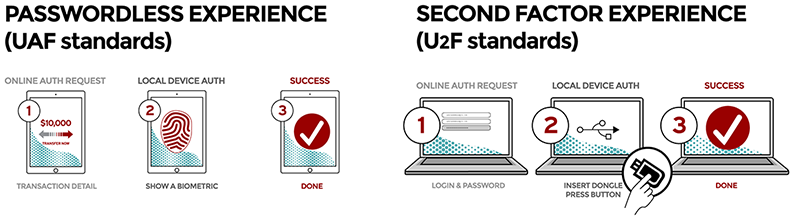
  • Developing technical specifications that define an open, scalable, interoperable set of mechanisms that reduce the reliance on passwords to authenticate users.
  • Operating industry programs to help ensure successful worldwide adoption of the Specifications.
  • Submitting mature technical Specification(s) to recognized standards development organization(s) for formal standardization.
You may want to start with the specifications overview:
The FIDO (Fast IDentity Online) Alliance is a 501(c)6 non-profit organization nominally formed in July 2012 to address the lack of interoperability among strong authentication devices as well as the problems users face with creating and remembering multiple usernames and passwords. The FIDO Alliance plans to change the nature of authentication by developing specifications that define an open, scalable, interoperable set of mechanisms that supplant reliance on passwords to securely authenticate users of online services. This new standard for security devices and browser plugins will allow any website or cloud application to interface with a broad variety of existing and future FIDO-enabled devices that the user has for online security.

Synaptics gör pekplatta med fingeravtrycksläsare för bärbara datorer.


http://www.sweclockers.com/nyhet/19750-synaptics-gor-pekplatta-med-fingeravtryckslasare-for-barbara-datorer


Precise Biometrics avtal med Synaptics.

(SIX) Precise Biometrics har ingått ett avtal med Synaptics för 
licensiering av Precise Biomatch Mobile. 

Det framgår av ett pressmeddelande. 

Licensavtalet ska göra det möjligt för Synaptics att inkludera 
Precise Biometrics fingeravtrycksalgoritm i bolagets 
fingeravtryckssensorer och lösningar med touch-funktionalitet. 

"Avtalet med Synaptics stärker vår position som en oberoende 
leverantör av fingeravtrycksalgoritmer for mobila enheter. Vår 
fingeravtrycksalgoritm har en branschledande prestanda och avtalet är 
ett viktigt steg i den fortsatta kommersialiseringen av vår 
teknologi", säger Håkan Persson, vd för Precise Biometrics.


Gooogle & Motorola valde bort Synaptics.

Google och Motorola valde bort fingeravtryckssensor från Synaptics i Nexus 6 - källa

Skickad: 2014-10-16 09:54:47
Google presenterade på onsdagen sin nya smartphone Nexus 6 som tillverkas av Motorola. Det har under året förekommit spekulationer om att modellen skulle ha en fingeravtryckssensor men så blev inte fallet och anledningen uppges vara att Motorola haft problem att få tekniken att fungera tillräckligt väl.

En källa i USA med insyn i utvecklingsprocessen hävdar att Motorola samarbetat med Synaptics men i sista stund valt att exkludera fingeravtryckssensorn då den inte levde upp till kraven.

Personen, som vill vara anonym, säger till FinWire att det ska ha rört sig om en nyutvecklad touchsensor från Synaptics, men Motorola och Google ska sent i utvecklingsskedet ha insett att tekniken inte höll måttet för en lansering just nu. Synaptics har tidigare uppgett att deras första touchsensor ska lanseras under andra halvåret, men någon officiell presentation har ännu inte skett.

Ett flertal aktörer försöker just nu ta sig in på den heta biometrimarknaden, som i dagsläget domineras av Synaptics och Fingerprint Cards. Motorolas beslut att välja bort sensor är dock ännu ett tecken på att det finns stora tekniska utmaningar med att få fram en tillräckligt användarvänlig och funktionsduglig sensor. Nyligen avslöjade FinWire att även kinesiska Meizu haft tekniska problem med tekniken och en källa uppgav att de tvingats byta leverantör från norska IDEX till Goodix.

I dagsläget har världens tre största smartphonetillverkare lanserat mobiler med fingeravtryckssensorer. Apple, som tidigare förvärvat sensortillverkaren Authentec, använder en touchsensor i sina iPhone-modeller, medan Samsung anlitar Synaptics som leverantör av swipesensorer till bland annat Galaxy S5 och Note 4. Nyligen följde även kinesiska Huawei, som är världens tredje största tillverkare, efter och lanserade sin Ascend Mate 7 med en touchsensor från Fingerprint Cards.
Stefan Linnér
stefan.linner@finwire.se, 0701-15 39 64
Nyhetsbyrån Finwire