Chinese company’s latest smartphone features dual-sim, decent processor, screen and camera, but modified Android software isn’t the best
The brief for Huawei’s Honor 7 is straightforward: make a solid smartphone that don’t break the bank.
It doesn’t pretend to be a “flagship killer”, and isn’t, but in a market that is full of good offerings for under £250, including the new OnePlus 2 and third-generation Moto G, can the, arguably, fastest fingerprint scanner in the business make it stand out?
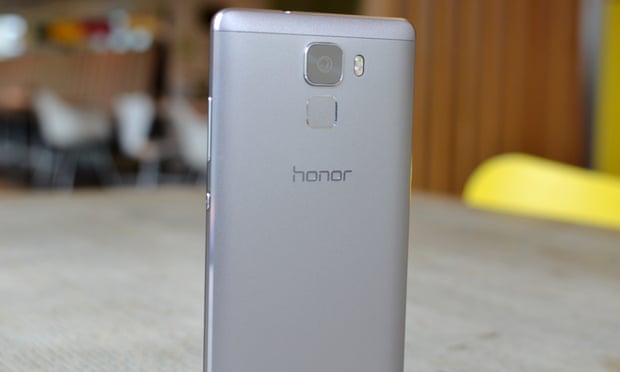
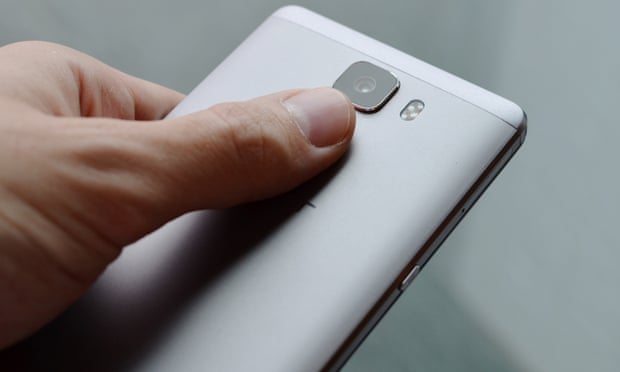
A very fast and effective fingerprint sensor is positioned under the camera on the back, right in line with where your index finger sits. Photograph: Samuel Gibbs for the Guardian
The Honor 7 has a simple, relatively attractive design. The body is metal, although it has a coating on it that gives it a premium plastic-like feel. The front is all glass with a selfie cam and front-facing flash. The rear has a camera that sticks out and a fingerprint scanner below – it’s all quite understated.
Advertisement
Build quality is just above average: the body flexes when twisted and the plastic top and bottom corners feel like they will be marked quite easily if dropped.
The 5.2in full HD screen looks remarkably crisp and good, but side-by-side with the quad HD screens with higher pixel densities such as the 5.1in screen of the Galaxy S6 it is noticeably less dense.
The Honor 7 compares favourably to the OnePlus 2, which has a similar 1080p screen.
At 8.5mm the phone is relatively thin and light for the mid-range price. Compared to the OnePlus 2 for instance, it is 1.35mm thinner and 18g lighter.
Beyond the standard power and volume buttons, the Honor 7 also has an extra customisable button. A short press, long press and double press can all be tied to custom actions such as launching the camera or used to launch an app such as Twitter or Facebook. It works well, but gets pressed quite a lot by accident as it is opposite the power and volume buttons.
Specifications
Screen: 5.2in full HD LCD (424ppi)
Processor: Octa-core Huawei Kirin 935
RAM: 3GB of RAM
Storage: 16GB + microSD card
Operating system: Android 5.0 “Lollipop” with Emotion UI
Camera: 20MP rear camera, 8MP front-facing camera
Connectivity: Dual-sim, LTE, Wi-Fi, NFC, Bluetooth 4.1 and GPS
The Honor 7 isn’t the fastest smartphone on the block, but its own-brand processor is capable of performing most tasks without issue. Photograph: Samuel Gibbs for the Guardian
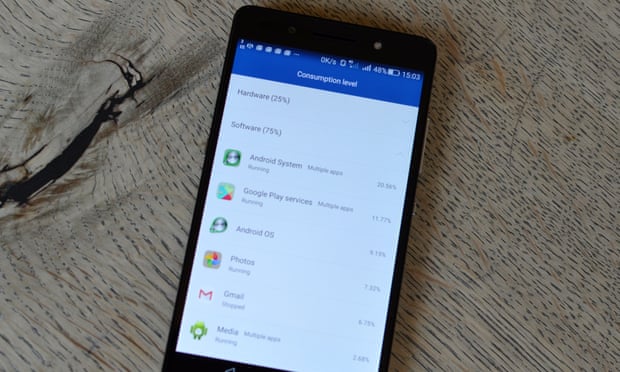
The Honor 7 contains Huawei’s Kirin 935 octa-core processor. Perfomance is solid, if not astounding, only stuttering slightly with some graphically rich gaming, while 3GB of RAM is plenty for multitasking according to the built-in RAM monitor.
The phone handled everything I threw at it without issue, and didn’t suffer from any heat issues, unlike Qualcomm’s Snapdragon 810.
The battery lasted around one day on the phone’s “Smart” power profile, which claims to best balance performance with battery life, returning to the charger at night with 20% battery left. That was with hundreds of push notifications, email, Twitter, Facebook, music streaming and an hour of browsing.
It’s worth noting that the screen’s 50% brightness was far too dim to see anything, and the automatic brightness setting often made the screen quite bright, which will eat into the battery life.
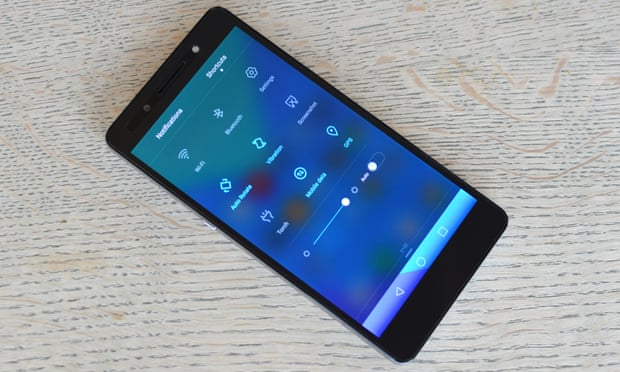
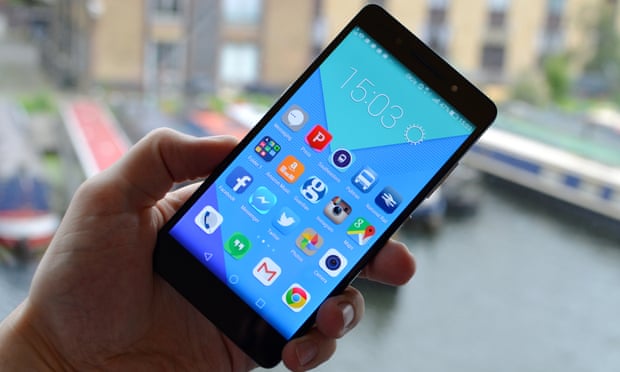
The Honor 7 runs Huawei’s modified version of Android 5.0 called “Emotion UI”. It is the same version as running on the Huawei P8 and has the same benefits and pitfalls.
Briefly, there is no app drawer making it like an iPhone with every app on the home screen; the notification tray looks and behaves differently with some apps spitting out multiple notifications; most app icons have a coloured background, which looks a mess, and other apps have custom icons, which look a bit warped, such as Instagram.
The standard Android Lollipop experience is much more attractive and slick.
The Honor 7 comes with a 20-megapixel camera on the back and an 8-megapixel fixed-focus selfie cam which, unusually, has its own flash placed on the other side of the handset’s ear speaker.
Images from the rear camera are rich in detail and relatively accurate in colour. The f/2.4 lens isn’t quite up to par with the best in the industry, from LG and Samsung with their 1.9 and 2.0 lenses, which means a shallow depth of field and pleasing bokeh effect is difficult to obtain.
Overall, it’s a decent camera with good low-light performance, on par with the likes of the OnePlus 2.
The front-facing camera can take good images but lacks range and, being fixed focus, is a curious choice for an 8-megapixel camera. It means that everything ends up in focus –
The Honor 7 comes with a 20-megapixel camera on the back and an 8-megapixel fixed-focus selfie cam which, unusually, has its own flash placed on the other side of the handset’s ear speaker.
Images from the rear camera are rich in detail and relatively accurate in colour. The f/2.4 lens isn’t quite up to par with the best in the industry, from LG and Samsung with their 1.9 and 2.0 lenses, which means a shallow depth of field and pleasing bokeh effect is difficult to obtain.
Overall, it’s a decent camera with good low-light performance, on par with the likes of the OnePlus 2.
The front-facing camera can take good images but lacks range and, being fixed focus, is a curious choice for an 8-megapixel camera. It means that everything ends up in focus – or, if you get too close, nothing is in focus. The LED flash is also not very bright.
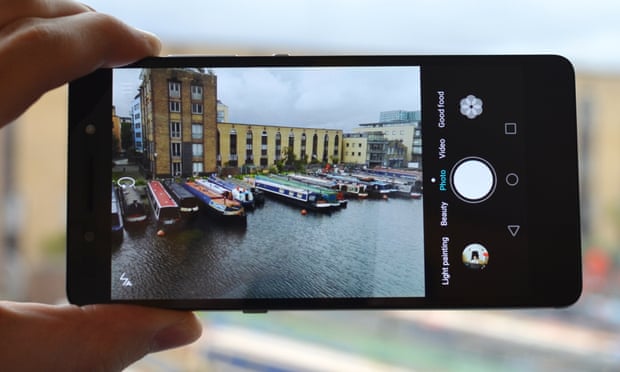
The camera app is very iPhone-like. A simple photo selector on the left, with options to enable HDR and a load of other features buried behind a menu. It can sometimes be a bit sluggish to take photos. The camera’s beauty modes can also produce some scary pale, bug-eyed photos.
The fingerprint on the back lines up with an index finger when holding it facing the screen, but can also be used to silence alarms or other functions from the rear. Photograph: Samuel Gibbs for the Guardian
Arguably the best fingerprint scanner on the market, and the best thing about the Honor 7, the sensor just below the camera on the back is so quick and accurate you think it’s broken.
It’s easy to hit with your index finger and unlocks the phone in under 0.5 seconds. A simple tap is enough – no long pressing and hoping. It’s even faster and more accurate than Apple’s much vaunted Touch ID on the iPhone.
Unfortunately, like the OnePlus 2, the Honor 7’s fingerprint sensor can’t be used in third-party apps such as Evernote or LastPass. Android 6 Marshmallow will introduce native fingerprint support into Android and hopefully expand support for the Honor 7 and other smartphones’ fingerprint sensors, beyond Samsung’s.
The Honor 7 is relatively manageable for a smartphone with a 5.2in screen. Photograph: Samuel Gibbs for the Guardian
Verdict
The Honor 7 is a solid mid-range smartphone with some great features. The fingerprint sensor is the fastest in the business – all fingerprint sensors should be that easy and quick to use.
The camera is solid, it has dual-sim or microSD card support, and the extra customisable button is a nice touch.
Its biggest problem is its software. Emotion UI is just not as attractive, user friendly or well designed as the standard Android 5 Lollipop experience.
Overall, the Honor 7 is good value from a more mainstream Chinese smartphone brand, that you actually buy from a store, but may not be enough to justify spending £100 more than a solid budget offering.
Thanks to TENAA listing, video as well as images leaked earlier, we had a fair idea about the upcoming smartphone. Looks like, almost all of the specs leaked as well images were bang on target.
The phone comes with an all metal design inside a sleek body. In fact, it looks like the phone is inspired from the Huawei P8, which is not a bad thing considering we thought that the design was quite refined and premium.
The Huawei Honor 7 comes with a 5.2-inch full HD 1080p display with Kirin 935 octa-core 64-bit chip under the hood. There will be 3GB of RAM on board with 16GB / 64GB of internal storage options.
Unlike the Honor 6 Plus which came with dual camera design, the Honor 7 uses a single powerful sensor, a 20MP Sony IMX230 as the primary camera with Phase Detection AutoFocus. The camera will be protected by sapphire glass which is scratch resistant. At the front, you will find an 8MP shooter. Naturally, given the flagship status, expect a lot of camera centric features such as slo-mo video shooting, personal filters, time lapse mode and even a special food mode.
Other important specs include Android 5.0 Lollipop version with EMUI 3.1 on top. There will be a 3100mAh battery on board with 9V2A fast charge technology. The company claims that fast charge enables the user up to 1 hour of talktime with just 5 minutes of charge time.
Another highlight of the Honor 7 flagship is its fingerprint sensor at the back. The placement is quite similar to the Huawei Mate 7. The company claims that the fingerprint ID is one of the best. The sensor can identify and unlock the phone in just 0.5 seconds. User can add up to 5 different fingerprints on the device. Moreover, the sensor is reportedly self learning, which means it will improve in accuracy over a period of time.
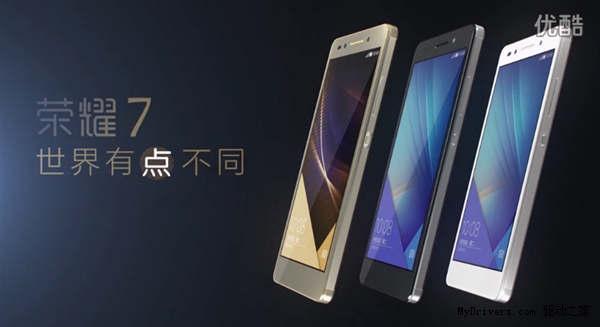
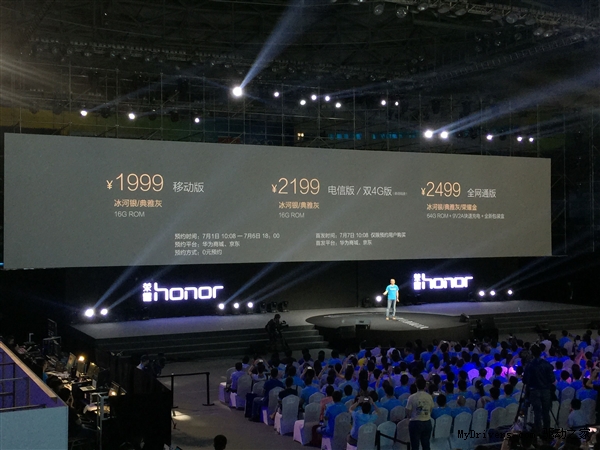
As for the connectivity, the phone supports dual 4G networks with full connectivity support. The flagship will be available in three different colors namely silver / gray / gold. The pricing starts at 1999 Yuan and users in China can pre-order it till July 6. The actually shipping starts from July 7.
Its good to see that Huawei has upgraded the design (metal body) as well as the specifications in this new generation flagship. Considering the overall package, the Honor 7 turns out to be a great device in under $325!
So, what do you think about this flagship? Are you impressed?